Predictive Analytics for Retention: Identifying Flight Risks Before Employees Leave

How Total Rewards teams can use data, ethical AI, and human judgment to move from reactive turnover management to proactive retention strategy.

The resignation letter arrives, the exit interview is scheduled, and the search for a replacement begins. For many organizations, this reactive cycle remains the default approach to retention – and it is expensive. When recruitment, onboarding, lost productivity, and business disruption are considered, employee turnover can create a significant financial and operational burden.

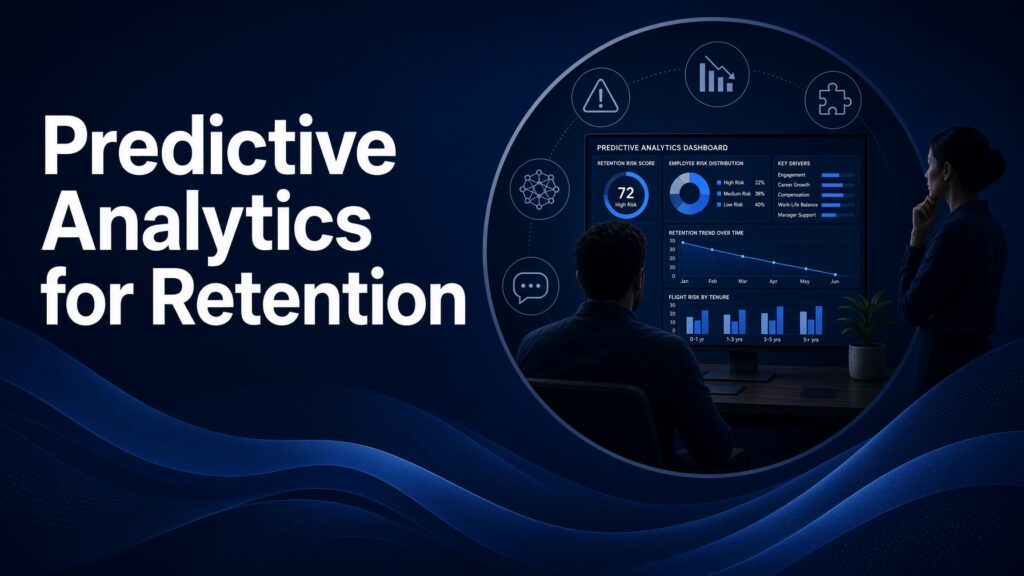
Predictive analytics offers a more proactive path. By identifying early warning signs weeks or months before an employee resigns, organizations can intervene sooner, address the underlying drivers of disengagement, and design retention strategies that are both targeted and humane.

The Power of Early Intervention

Predictive models analyze behavioral, demographic, and organizational data to flag employees who may be at risk of leaving before they make a final decision. Organizations using AI-driven predictive analytics have reported meaningful turnover reductions, including reported reductions of 25% to 40% in some HR analytics use cases.[1]

The strongest retention signals often reveal that employees stay for more than compensation alone. Advanced machine learning models analyzing large employee datasets suggest that a modest improvement in company pride – an employee’s emotional connection to the organization’s brand, mission, and purpose, can meaningfully reduce expected turnover. Wotter.ai reported that its analysis of more than one million real employee data points produced flight-risk models with 86% accuracy and that simulated improvements in company pride produced the largest reduction in expected leavers among the engagement drivers tested.[2]

However, predictive analytics should not be treated as a stand-alone solution. As one industry expert cautions, “AI can help employers predict attrition, but it can’t prevent it on its own. If someone is disengaging, it might be burnout, not betrayal. Without the human context, you risk losing someone who just needed support.”

Beyond Internal Data: Building a Fuller View of Risk

The most sophisticated predictive models don’t rely solely on internal HR data. They integrate multiple data streams to build a complete picture of flight risk:

Data Source

Signals Analyzed

Internal HR Data

Tenure, performance ratings, engagement scores, salary position, promotion history, and manager relationships

Behavioral Signals

Email sentiment, meeting participation, calendar patterns, training completion, and changes in collaboration behavior

External Context

Industry trends, regional labor market pressure, role scarcity, and compensation benchmarks

When combined responsibly, these data sources create a more nuanced view of risk across six practical dimensions: tenure, performance, salary competitiveness, engagement, promotion timing, and manager relationships.

Predictive Models in Action
Case Study: Wotter.ai’s Flight Risk Prediction

The employee retention platform Wotter.ai analyzed more than one million employee data points to develop machine learning models designed to identify likely flight risks. Its simulations highlighted the outsized role of company pride, suggesting that improvements in employees’ connection to organizational purpose can have a stronger retention impact than equivalent efforts focused only on pay or progression.[2]

Case Study: Research on Technology Employee Turnover

Research applying decision tree classifiers, logistic regression, random forests, and other machine learning techniques to employee turnover has shown the value of combining performance, workload, satisfaction, and engagement indicators. A 2025 systematic review of 58 studies found that random forest was the most widely used technique and that job satisfaction was one of the most important predictors of turnover.[3]

Case Study: Applying Churn Analytics to Talent

Customer churn models used in commercial analytics demonstrate a useful parallel for workforce strategy. By unifying engagement, support, and behavioral data, organizations can identify individuals who are more likely to disengage and then trigger targeted interventions before the relationship breaks down.

Behavioral Signals Worth Monitoring

Predictive models track subtle changes in employee behavior that often precede resignation:

  • Email sentiment analysis: Detecting increasingly negative or formal tone in communications
  • Meeting participation patterns: Reduced engagement in team discussions
  • Calendar behavior: Declining acceptance rates for optional meetings
  • Project ownership changes: Decreased volunteering for high-visibility assignments
  • Training completion rates: Declining participation in professional development
  • Performance metrics: Subtle drops in productivity or quality indicators

The Human-in-the-Loop Imperative

Predictive analytics can illuminate patterns, but it should not become a substitute for leadership judgment. AI may serve as a flashlight, but it should not become a spotlight. The goal is not to catch employees preparing to leave; it is to understand why they might consider leaving and to respond with meaningful support.

Total Rewards professionals are especially well positioned to interpret these insights. They can connect model outputs with knowledge of culture, leadership practices, team dynamics, and individual circumstances—areas where algorithms alone are limited. This blend of predictive power and human judgment is what makes analytics-driven retention both effective and responsible.

Conclusion: From Prediction to Prevention

Predictive analytics represents a fundamental shift in how organizations approach retention. By identifying risk earlier, integrating richer data sources, and keeping human judgment at the center of decision-making, Total Rewards teams can move beyond reactive turnover management and build stronger, more resilient workforces.

The message for leaders is clear: retention is not only about compensation. Employees are more likely to stay when they feel connected to the organization, supported by their managers, and confident about their future. Predictive tools can help surface the warning signs, but people-centered action is what ultimately prevents avoidable turnover.

References
1. Appliview. “Predictive Analytics in HR: Reducing Turnover Using AI.” Available at: Predictive Analytics in HR: Reducing Turnover Using AI.
2. The REC / Wotter. “Does AI increase your employees being a flight risk?” Available at: Does AI increase your employees being a flight risk?.
3. Talebi, H., Khatibi Bardsiri, A., and Khatibi Bardsiri, V. “Machine Learning Approaches for Predicting Employee Turnover: A Systematic Review.” Engineering Reports. Available at: Machine Learning Approaches for Predicting Employee Turnover: A Systematic Review.

Related Articles​

  • November 5, 2026
    5 Approaches to More Effective Total Rewards Communication

    5 Approaches to More Effective Total Rewards Communication Total Rewards communication often falls short of its intended impact. Schaefer [9] reports that only 40% of employees understand their Total Rewards; this figure is cited from professional commentary rather than a verified primary study. Annual statements can provide a backward-looking snapshot rather than guidance on current

  • November 5, 2026
    Pay Transparency: Turning Compliance into Competitive Advantage

    Pay Transparency: Turning Compliance into Competitive Advantage When the board asks, “What keeps us exposed?” the reflex answer is cyber, regulatory, or geopolitical risk. Pay is rarely on the list until it is a single leaked salary spreadsheet, a candidate who walks away because no range was disclosed, or a gender pay gap figure published

  • November 4, 2026
    Your Employees Don’t Understand Their Total Rewards—and It’s Costing You

    Your Employees Don’t Understand Their Total Rewards—and It’s Costing You The Communication Paradox: Better Informed, Less Satisfied A counterintuitive trend is emerging in today’s workplaces: employees feel better informed about their benefits than ever, yet satisfaction is declining. WTW’s latest EX Intelligence report found that 84% of employees feel well informed about company benefits, up